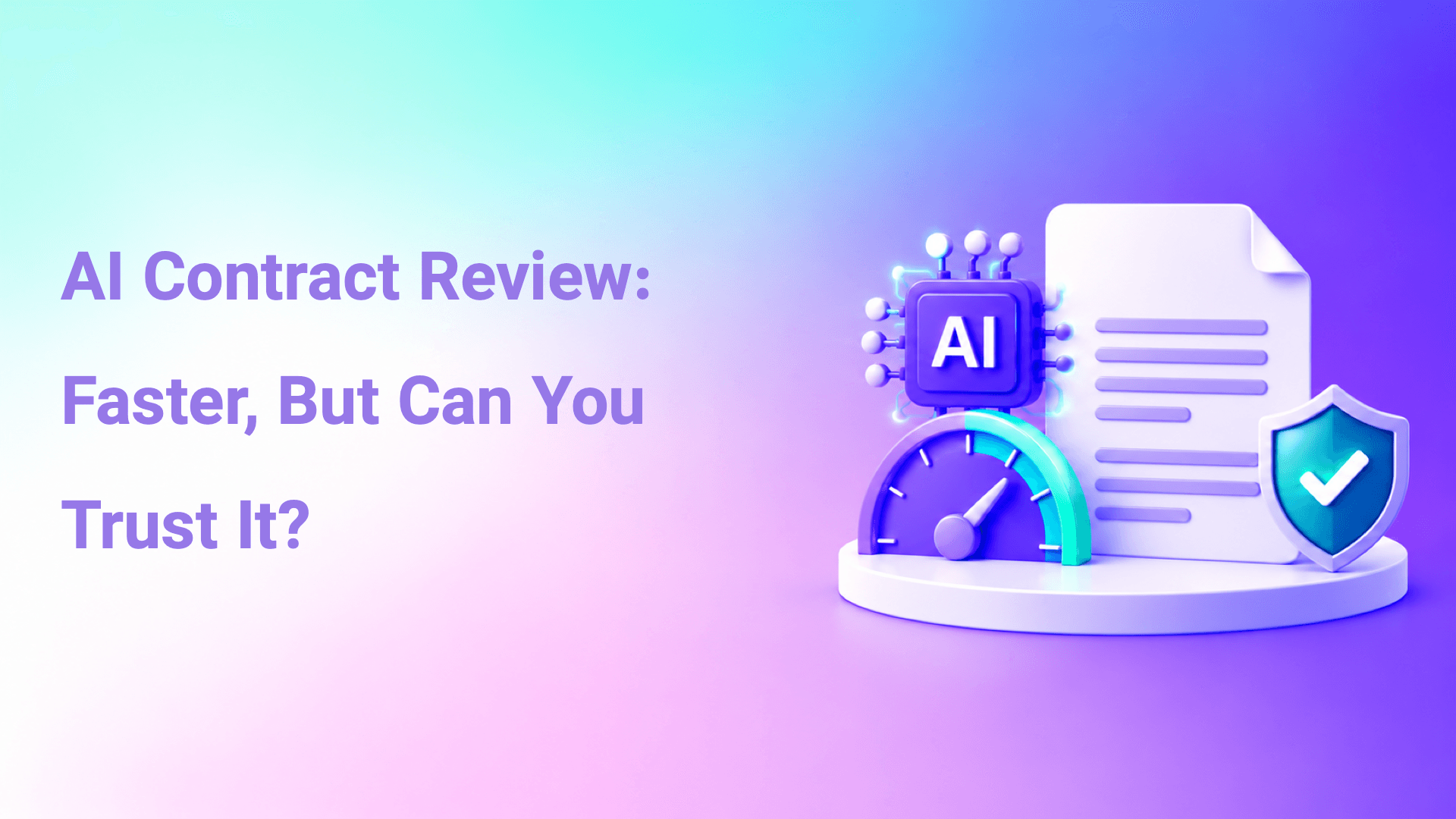
AI contract review: faster, but is it reliable?
AI contract review means a language model reads the contract before the legal reviewer does: it extracts the clauses, compares them with the organization's templates and policies, and pinpoints where the risks lie. The result is reliable to the extent that every flag is grounded in text that actually exists in the contract, the decision to accept or reject stays with an accountable person, and everything that happened is kept in an audit trail.
Signit's AI contract assistant was designed on this basis: it works inside the contract management workflow itself and applies the organization's policies to every contract it reviews. This article explains what the assistant offers legal and procurement departments, the limits of relying on it, and the questions to ask before using it, as part of the contract lifecycle management guide.
Quick summary
- Signit's assistant handles contract drafting and review, flags risks against the organization's policies, summarizes contracts, and tracks obligations and renewals after signing.
- It works in both Arabic and English, and Signit states that customer data is not used to train models.
- The speed is clear from the first use; reliability comes from organizing the review around the assistant: grounding every flag in the clause text, human approval of the decision, and documentation in the audit trail.
- The higher a contract's value or the more sensitive its data, the larger the legal reviewer's role.
- SDAIA's AI ethics principles and the Personal Data Protection Law (PDPL) make human oversight and accountability the foundation of use.
Table of contents
- What does Signit's AI contract assistant offer?
- Where does AI contract review outperform manual review?
- Where are the limits of AI in contract review?
- How do you measure an AI contract assistant's reliability before adopting it?
- Which tasks go to the AI contract assistant, and what stays with the legal reviewer?
- How does AI contract review fit the regulatory framework in Saudi Arabia?
- What are the common mistakes when adopting an AI contract assistant?
- How do you build a reliable review workflow in your legal department?
- Frequently asked questions about AI contract review
- Conclusion
What does Signit's AI contract assistant offer?
Signit's AI contract assistant is an AI tool that covers the contract from its first draft through to post-signature tracking. It is built on large language models (LLMs): systems trained on huge volumes of text that understand the meaning of legal wording rather than simply matching words.
Your AI contract management assistant works across five core functions:
- Drafting: creating the contract from text prompts or starting from the organization's approved templates.
- Review and editing: amending clauses and suggesting improvements until an approved final version is reached.
- Risk analysis: flagging deviations from standards, identifying risks, and applying company policies to the contract.
- Summarization: summaries that pull out the key terms and explain the contract in plain language for non-specialists.
- Post-signature management: extracting obligations, tracking key dates, and managing renewals.
Your AI contract management assistant: from drafting the contract to tracking it after signing
Contract drafting
Create contracts from prompts and approved templates.
Review and editing
Improve clauses and reach the final version.
Risk analysis
Detect risks and deviations and apply policies.
Contract summarization
Pull out the key terms in clear, simple language.
Post-signature management
Track obligations, deadlines, and renewals.
The assistant differs from general-purpose chat tools in that it works through specialized agents for each contracting task and carries out what it is asked to do inside the platform's workflow, with governance controls that define what is permitted. It was also designed in Arabic from the ground up for the Saudi market, and supports Arabic and English for drafting and summarizing clauses and for negotiation inputs.
To apply policies, the assistant needs a written reference, usually the negotiation playbook: an internal document that sets out the organization's position on each clause, what it accepts, what it rejects, and what is open to negotiation. The more precise this playbook, the closer the assistant's flags will be to what the legal team expects.
Where does AI contract review outperform manual review?
It outperforms on volume and consistency: the assistant applies the same standard to the first contract and the hundredth, unaffected by workload pressure or piling files. This advantage is especially clear in procurement departments that repeatedly receive similar supplier contracts. The assistant separates contracts that match the approved templates from those that depart from them, and points the legal counsel to the clauses that need attention instead of reading every contract in full.
The assistant applies the organization's policy the same way in every review, whereas reviewers' judgment of the same clause may vary from person to person. The condition is that the policy is clearly written and up to date. Bilingual contracts are also common in Saudi Arabia, and the assistant's support for Arabic and English makes it possible to review both versions and spot differences between them, one of the places where a flaw can easily be missed in a manual reading.
Where are the limits of AI in contract review?
Its limits lie in decisions that require information not written in the contract, such as the nature of the relationship with the supplier, what was said during negotiation, and how the clause is interpreted under Saudi laws. These limits apply to any AI assistant, which is why reliable use is built on knowing them.
An AI assistant for review, with the final decision in the specialist's hands
Hallucination
It may generate information that is not in the contract.
Business context
It does not know the details of the negotiation or the relationship with the parties.
Local regulations
The review must be checked for compliance with the Saudi laws in force.
Input quality
Analysis accuracy depends on how clear the contract is and how accurate the extracted text is.
Hallucination: a confident answer about something that isn't there
Hallucination is when the model writes information that looks correct and coherent but does not exist in the source. In contracts, it can appear as a summary that mentions a termination clause that was never written, or an obligation attributed to the other party. The simplest protection is not to accept any flag that does not reference the clause number and its text.
Business context
The assistant may flag that the late-delivery penalty in a supplier contract is lower than the organization's policy requires. But it does not know that this supplier may be the only one able to deliver on time, or that the penalty was reduced in exchange for a price discount. That judgment belongs to the procurement team and the legal department.
Local legal interpretation
Language models are mostly trained on legal texts from many jurisdictions, so they may suggest wording that is common elsewhere but not consistent with Saudi laws or with the approved forms used in government tenders. And because laws and regulations are amended, the reviewer needs to verify that the review is based on the text currently in force.
Input quality
If the contract is a poor-quality scanned image, the text that reaches the model is incomplete from the start. That is why the output of optical character recognition (OCR), which converts an image of a document into text, should be reviewed before relying on any analysis built on it.
How do you measure an AI contract assistant's reliability before adopting it?
Its reliability is measured by its ability to substantiate the results it produces. The following table brings together the questions an evaluation team should ask, what Signit states about its assistant, and what remains to be verified during the demo.
| Evaluation criterion | The question to ask | What Signit states about its assistant |
|---|---|---|
| Applying the organization's policies | Does it compare the contract with our policies and approved templates, or with a general standard? | Flags deviations from standards and applies company policies, with governance controls |
| Arabic legal drafting | Does it handle Arabic and bilingual contracts with the same accuracy? | Designed in Arabic for the Saudi market, and supports Arabic and English |
| Data use | Is the text of our contracts used to train models? | Customer data is not used to train models, and models that do not retain data are used |
| Data hosting location | Where are contracts processed and stored? | Hosting inside Saudi Arabia and compliance with the Personal Data Protection Law |
| Grounding in the text | Does it link every flag to the clause number and its verbatim text? | Ask to see it in practice during the demo |
| Audit trail | Does it record what the assistant suggested and what the reviewer accepted or rejected? | The audit trail is part of the Signit platform |
| Human approval | Does approving a change require explicit consent from the user? | Changes are suggestions for reaching an approved version |
An audit trail is a chronological record of every action on the document: who opened it, who edited it, when, and what changed. When AI is used, it is advisable for the trail to include the assistant's suggestions and the reviewer's decision on each one.
Put the evaluation questions to Signit's assistant
Try the AI contract assistant on your department's real contracts, and ask it to link every flag to the clause number and its text.
Which tasks go to the AI contract assistant, and what stays with the legal reviewer?
The higher a contract's value, or the greater the sensitivity of its data or its regulatory impact, the more the assistant's role is limited to sorting and flagging, and the more the decision moves entirely to the legal reviewer.
| Contract type or task | Risk level | AI contract assistant's role | Legal reviewer's role |
|---|---|---|---|
| Non-disclosure agreement (NDA) on the approved template | Low | Full comparison with the template and flagging of any deviation | Quick approval or review of deviations only |
| Purchase orders and recurring supplier contracts | Low to medium | Extracting prices, terms, delivery conditions, and penalties | Reviewing clauses that conflict with procurement policy |
| Mid-value service contracts | Medium | Summarizing and flagging liability, renewal, and termination clauses | Reviewing and negotiating the flagged clauses |
| Contracts involving personal data processing | High | Flagging processing, transfer, and retention clauses | Verifying compliance in coordination with the data protection officer |
| Government tender and procurement contracts | High | Matching documents against terms and specifications and flagging gaps | Full regulatory review under the Government Tenders and Procurement Law |
| Strategic or high-value contracts | Very high | Initial summary and comparison with previous versions | Full human review and the negotiation decision |
| Interpreting a disputed clause | Very high | Retrieving relevant clauses and correspondence only | Interpretation and legal opinion |
This classification also ties into the signing stage: a contract that required full human review usually calls for a higher level of assurance when it is signed, as explained in the article electronic signature levels and when to use each.
How does AI contract review fit the regulatory framework in Saudi Arabia?
Before signing, this use is governed by two main references: the AI ethics principles and the Personal Data Protection Law. The Electronic Transactions Law then governs the signing stage.
SDAIA's AI ethics principles
In September 2023, the Saudi Data and AI Authority (SDAIA) issued the AI ethics principles, of which there are seven: integrity and fairness; privacy and security; humanity; social and environmental benefits; reliability and safety; transparency and explainability; and accountability and responsibility. The principles classify AI systems into four risk levels, starting with little or no risk and ending with unacceptable risk, with the required oversight increasing as the level rises.
In the legal department, this translates into two practical requirements: the reviewer knows the reason behind every flag, and the decision to approve the contract is attributed to a specific person.
The Personal Data Protection Law
A contract contains names, ID numbers, contact details, and bank accounts. Sending this data to an AI tool counts as processing it under the Personal Data Protection Law, so its controls on purpose limitation, disclosure, and transferring data outside the Kingdom apply. That is why hosting location and data use policy are among the first things to ask about when choosing an assistant. The article on digital consent under the PDPL explains how to build consent flows that meet these controls.
The Electronic Transactions Law
The assistant's role in review ends before signing. The contract's legal validity is then governed by the Electronic Transactions Law, which gives electronic records and signatures their legal effect once they meet its requirements. For more detail on these requirements, see the article on the Electronic Transactions Law in plain language.
What are the common mistakes when adopting an AI contract assistant?
The most common is treating the assistant's output as a final legal opinion, when it is a preliminary analysis that needs to be verified by the responsible reviewer.
This mistake often shows up in how summaries are handled: a summary makes clauses easier to find, but it is no substitute for reading the clause itself in important contracts. It also shows up when the assistant is run without a negotiation playbook or approved templates, so it measures the contract against general standards that do not reflect the organization's policy.
A recurring mistake in requesting departments is pasting the contract text into a general-purpose chat tool to get a quick summary, which can move personal data and confidential information outside the organization's control. The alternative is to carry out the review inside the contract platform itself, where the data is subject to the approved hosting policies and permissions.
Some teams measure the tool by its speed alone, yet a fast tool that misses a material clause can cost more than a slower manual review. Not recording the reviewer's decision and its reasons also makes it harder later to explain why the contract was signed in its final form. Finally, an outdated negotiation playbook leads the assistant to apply a policy that is no longer approved.
How do you build a reliable review workflow in your legal department?
A reliable workflow rests on a clear division of roles: the assistant reads the contract and flags risks, the reviewer makes the decision, and the action is documented in the audit trail. It can be put in place in six steps:
- Classify contracts by risk using the task allocation table above, and set the amount of human review required for each category.
- Write the negotiation playbook so that it sets out the organization's position on each key clause as clear rules, then adopt it as the reference for the assistant's policies.
- Do not accept any flag that does not reference the clause number and its text.
- Link the delegation of authority matrix to the risk level, so that no high-risk contract reaches signing before a qualified reviewer approves it.
- Record what the assistant suggested, and what the reviewer accepted, amended, or rejected.
- Test the assistant regularly on a sample of manually reviewed contracts, and compare what it caught with what it missed and what it flagged unnecessarily.
How do you build a reliable review workflow?
Risk classification
Set the level of review required for each contract.
Standardized policies
Set clear rules for negotiation and clause review.
Documented flags
Link every note to the relevant clause and text.
Assigned permissions
Route high-risk contracts to specialist review.
Recorded decisions
Document what the assistant suggested and what was approved or amended.
Continuous testing
Review the assistant's performance and compare it with human reviews.
In procurement departments, this workflow ties into compliance requirements for procurement and tenders, because applying the same terms to all suppliers is part of procedural integrity.
Frequently asked questions about AI contract review
Can AI be relied on to review contracts without a legal reviewer?
For standard, low-risk contracts, the assistant can handle most of the review, followed by a quick human approval. High-value contracts, or contracts that involve personal data, need human legal review, and the final decision and responsibility for it remain with the organization.
What does Signit's AI contract assistant offer?
It covers drafting contracts from text prompts or approved templates, reviewing clauses and suggesting improvements, flagging risks against the organization's policies, summarizing, and extracting obligations and tracking deadlines and renewals after signing.
Is my contract data used to train Signit's AI models?
Signit states that customer data is not used to train models, and that it relies on models that do not retain data, applying the principle of privacy by design.
Does Signit's assistant support Arabic legal drafting?
The assistant was designed in Arabic for the Saudi market and supports Arabic and English for drafting and summarizing clauses and for negotiation inputs. Even so, it is advisable to test it on a sample of the organization's contracts before adopting it.
What does hallucination mean in contract review?
It is when the model writes coherent information that does not exist in the contract, such as a clause that was never written or an obligation attributed to the wrong party. The best safeguard is to require every flag to reference the clause text.
Does the AI assistant replace the internal negotiation playbook?
No, it depends on it. Without an internal reference, the assistant compares the contract against general standards that may not reflect the organization's policy or its risk tolerance.
Does AI review affect the legal validity of the contract at signing?
A contract's legal validity depends on the requirements of the Electronic Transactions Law and the signature level used, not on how it was reviewed. The integrity of the text after approval is protected by digital certificates and public key infrastructure.
Who is responsible if the AI assistant makes a mistake?
Responsibility toward the contracting parties lies with the organization that approved the contract. The service provider's liability is defined by the service agreement, which is why its liability clauses deserve a careful read.
Conclusion
An AI contract assistant cuts the time spent reading, sorting, and extracting clauses, but trust in it is built by defining what is assigned to it, what the specialist reviews, and what is documented in the audit trail. The practical starting point is to classify contracts by risk and write the negotiation playbook, then evaluate the assistant using the questions in this article. To see where AI review fits in the full contract journey, see the contract lifecycle management guide.
Signit's AI contract assistant works inside a Saudi e-signature and contract management platform that states it serves more than 850 Saudi organizations across the public and private sectors. Your department can try it on its real contracts and put the evaluation questions above to it during the demo.
Try the AI contract assistant on your department's contracts
Ask the evaluation questions during the demo, and see how the assistant works inside the contract management workflow itself.
Book a demo of the AI contract assistantSources and external references
- Digital Government Authority (DGA): for the approved controls and requirements for digital transformation and government and electronic transactions.
- National Digital Identity System (Nafath): to confirm digital authentication standards and establish the legal validity of signatures by individuals and organizations.
- National Center for Electronic Transaction Services (Takamol / Wathq): to learn about direct integration mechanisms and real-time verification of commercial registration validity and corporate data.
- National Cybersecurity Authority (NCA): to learn about cybersecurity controls and the requirements for hosting sensitive data locally within Saudi Arabia.