Contract management from draft to archive — one contract, six stages: how does digital trust protect each stage?
Managing a contract from draft to archive involves six stages: drafting, review and negotiation, internal approval, signing, execution and obligation tracking, and finally renewal or termination and archiving. Each stage carries a different risk that threatens the contract's validity or value. Digital trust is the set of tools that proves who did what, when, and that the text has not changed since it was approved.
Most organizations focus on the moment of signing alone, even though many contract problems start before it or surface months after it. An outdated version reaches signature, a payment obligation misses its due date, or a contract renews automatically without anyone deciding it should. This article follows a single contract through its six stages and explains what matters to the legal counsel and the CFO at each one. It is part of the contract lifecycle management guide.
Quick summary
- A contract has six stages, and each stage has a main risk and a digital trust tool that addresses it.
- The core digital trust tools are identity verification, digital certificates, timestamps and audit trails.
- The legal counsel cares about sound drafting and the evidentiary weight of the signature, while the CFO cares about financial obligations and their due dates. A single platform serves both when it keeps the contract's data in one place.
- Signit's contract lifecycle management platform covers the stages from creation and negotiation through to signing, tracking and renewal.
- Many losses happen after signing: forgotten obligations, and automatic renewals that no one decided on.
In this article
- What does digital trust mean in contract management?
- What are the six stages of a contract, and what threatens each one?
- Stage one: drafting
- Stage two: review and negotiation
- Stage three: internal approval
- Stage four: signing
- Stage five: execution and obligation tracking
- Stage six: renewal or termination and archiving
- What the legal counsel and the CFO need
- Common mistakes in contract lifecycle management
- Frequently asked questions
- The bottom line
What does digital trust mean in contract management?
Digital trust in contract management is an organization's ability to prove three things about any contract: the identity of whoever handled it, the time of each action, and that the text has not been altered since it was approved. It relies on technical tools with legal effect, not on trust between people.
The first of these tools is identity verification, which confirms that the signer is the intended person; in the Kingdom it is done through Nafath and Absher. Next comes the digital certificate, an electronic file issued by a licensed trust service provider that binds a person's identity to a cryptographic key. A trust service provider is an entity licensed to provide electronic signature and verification services.
Then there is the timestamp, a trusted record of when a signature or action took place. Finally, the audit trail is a sequential record of everything that happened to the contract: who opened it, who edited it, who signed it, when, and from which device.
What are the six stages of a contract, and what threatens each one?
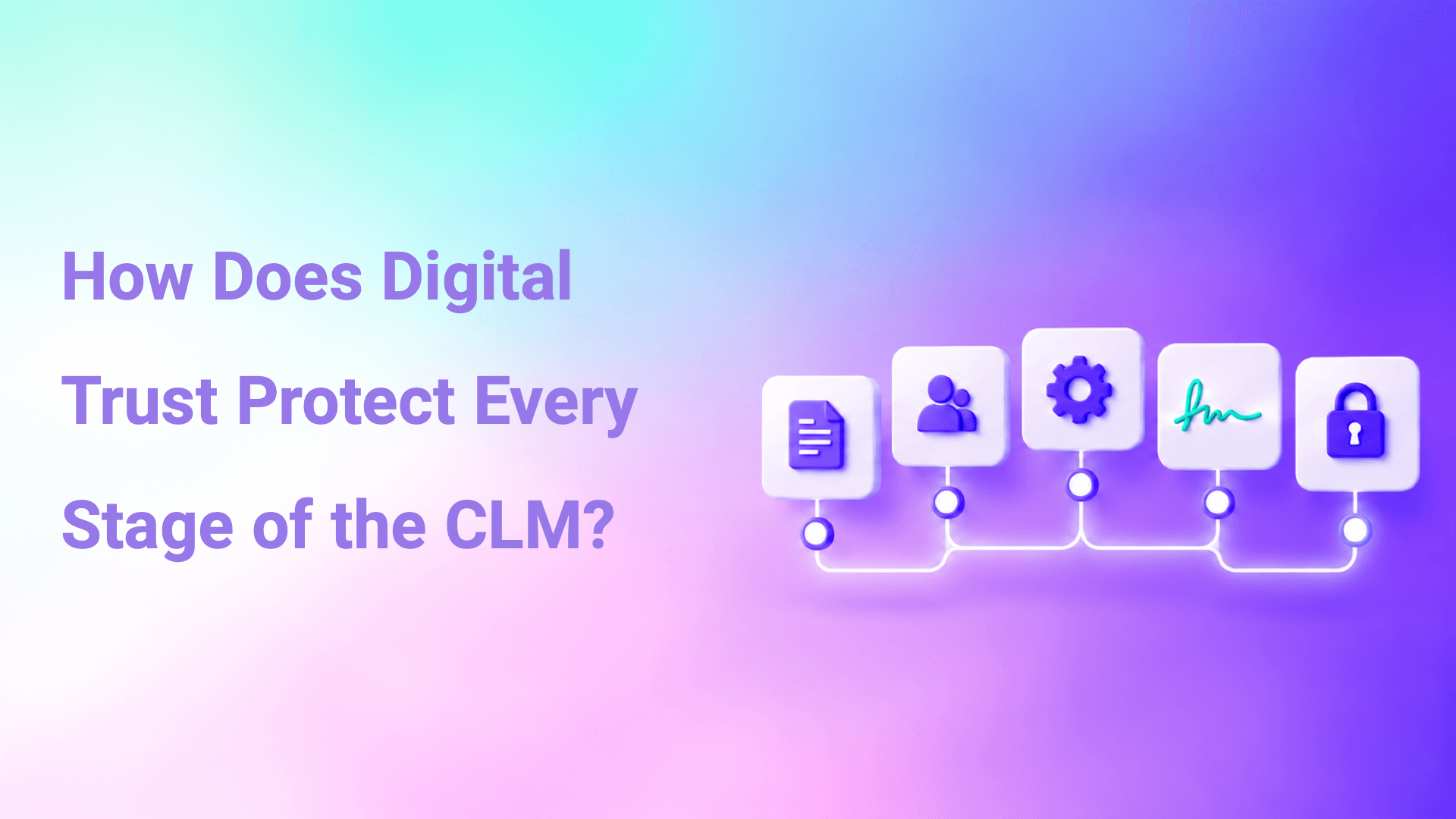
One contract, six stages
1Drafting
Risk: using an old template or unapproved clauses.
2Review and negotiation
Risk: untracked edits and multiple versions in circulation.
3Internal approval
Risk: approval by someone without the authority.
4Signing
Risk: identity impersonation or repudiation of the signature.
5Execution and obligation tracking
Risk: missed payment and delivery deadlines.
6Renewal or termination and archiving
Risk: unintended automatic renewal, or loss of the signed copy.
The following table summarizes the six stages, the main risk in each, and the digital trust tool that mitigates it.
| Stage | Main risk | Digital trust tool |
|---|---|---|
| 1. Drafting | Using an old template or unapproved clauses | Centralized approved templates and version control |
| 2. Review and negotiation | Untracked edits and multiple versions in circulation | Comments and change tracking in a single version |
| 3. Internal approval | Approval by someone without the authority | An approval workflow built on the delegation of authority matrix |
| 4. Signing | Identity impersonation or repudiation of the signature | Verification through Nafath and Absher, digital certificates and timestamps |
| 5. Execution and obligation tracking | Missed payment and delivery deadlines | Obligation extraction and deadline alerts |
| 6. Renewal or termination and archiving | Unintended automatic renewal, or loss of the signed copy | Contract expiry alerts and searchable digital storage |
Stage one: how does drafting start on a reliable foundation?
Reliable drafting starts from an approved template, not from the last similar contract someone found in their email. A contract built on an old version may carry a clause the legal department changed a year ago, or a liability cap that is no longer acceptable.
That is why specialized platforms keep approved templates in one place and create every contract from them. In Signit, the first draft can be created from templates or with the help of AI.
What matters to the CFO at this stage is that the contract's financial data, such as its value, payment schedule and term, is entered into defined fields from the start. These fields are what tracking is later built on.
Stage two: how do review and negotiation preserve the integrity of the text?
Review preserves the integrity of the text when it takes place on a single version in which every edit is recorded under its author's name. Exchanging Word files by email, on the other hand, produces multiple versions, and two weeks later no one knows which is the latest.
The risk here is not theoretical. An edit the other party makes to the penalty clause in the final round, unnoticed by anyone, goes to signature exactly as it is. Version control, together with comments and mentions inside the contract itself, makes every change visible and attributable to whoever made it.
When a contract contains personal data, such as names and ID numbers, review also becomes part of compliance with the Personal Data Protection Law, as explained in the article on digital consent under the PDPL.
Stage three: how do you ensure whoever approved the contract has the authority?
You ensure it by tying the approval workflow to the delegation of authority matrix, the internal document that defines who has the authority to approve each type of contract and each financial threshold. The contract does not move to signing until it has passed through the approvers assigned to it.
This stage matters most to the CFO. A contract that exceeds a certain financial threshold needs the finance department's approval, and a contract with unusual obligations needs the legal department's opinion. When the workflow is built automatically on these rules, it no longer depends on an employee remembering who the contract should go to.
Every approval is recorded in the audit trail with the approver's name and the time of approval, so it can be referred back to during internal or external review.
Stage four: what makes a signature reliable evidence?
A signature is reliable evidence when it proves the signer's identity, the time of signing, and that the text has not changed since. The Electronic Transactions Law gives an electronic signature its legal effect once it meets the law's requirements.
With Signit's electronic signature, the signer's identity is verified through Nafath and Absher, and company data through Wathq. Signit is a trust service provider licensed by the Digital Government Authority (DGA). An audit trail is attached to the contract showing who signed, when, and from which device.
Not every contract needs the same level of assurance. A standard non-disclosure agreement is different from a financing contract or a long-term partnership agreement.
All six stages in one place
From creation and negotiation through to signing, tracking and renewal, try Signit on your organization's contracts.
Stage five: how do you keep obligations from slipping after signing?
Obligations don't slip when the contract's clauses become trackable data: the date of each payment, the deadline for each delivery, and the penalty terms. If the contract stays a PDF file in a folder, tracking depends on people's memory.
This is the stage where a lot of money is lost without anyone noticing. A payment owed to the organization goes unclaimed because no one remembered its due date, a late-delivery penalty on a supplier is never applied, or a conditional discount goes unused. The CFO is the first person who needs to see these obligations in one place.
The Signit platform offers full-text search across contracts with filters and metadata, as well as post-signature obligation tracking. Its AI contract assistant can also extract obligations and track key dates from the contract text.
Stage six: what happens to a contract at renewal, termination or archiving?
When a contract's term ends, the organization needs a clear decision: renew on the same terms, renegotiate, or terminate. The biggest risk here is that the decision is made by silence, and the contract renews automatically because the notice deadline passed without anyone noticing.
That is why contract management platforms send alerts well before a contract expires. Signit states that its platform provides advance alerts for upcoming contract expirations and automates renewals. This gives the legal counsel time to review the terms, and gives the CFO a chance to renegotiate the price.
Archiving is what preserves the value of everything that came before. A digitally archived contract, together with its audit trail, can be found in minutes during a dispute or an audit, and remains evidence of the signers' identities and the time of signing. How long contracts are retained is determined by the applicable regulations and the organization's policy. Signit states that its data is hosted locally inside the Kingdom.
What do the legal counsel and the CFO need at each stage?
The legal counsel and the CFO look at the same contract from two different angles, and a single platform serves both when it brings the contract's data together in one place. The following table shows what each of them cares about at every stage.
| Stage | What matters to the legal counsel | What matters to the CFO |
|---|---|---|
| Drafting | Using the approved template and accepted clauses | Entering the value and payment schedule accurately |
| Review and negotiation | Tracking every edit to material clauses | The impact of edits on price and penalties |
| Internal approval | Reviewing unusual clauses | Staying within the financial limits in the delegation of authority matrix |
| Signing | The evidentiary weight of the signature and the signer's authority | Completing signatures quickly and starting execution |
| Execution | Regulatory obligations and termination terms | Payment dates, collections and penalties |
| Renewal and archiving | Retaining the evidence for the required period | The renewal decision and renegotiating the price |
What are the common mistakes in contract lifecycle management?
The most common mistake is treating each stage as if it were separate from the others. The draft is written in one program, reviewed over email, signed in a third tool, and then saved in a shared folder. Nothing links the version that was approved, the version that was signed, and the obligations that need to be tracked.
Another mistake is focusing on signing and neglecting what comes after it. An organization that invests in a strong electronic signature, then leaves obligation tracking to spreadsheets updated by a single employee, protects the contract when it is signed and loses its value during execution.
Finally, some organizations neglect the audit trail and only look at it when a dispute arises. It is better to review a sample of records periodically, to confirm that approval workflows work as designed and that contracts do not reach signing before all their approvals are complete.
Frequently asked questions about contract management from draft to archive
What are the six stages of the contract lifecycle?
Drafting, review and negotiation, internal approval, signing, execution and obligation tracking, and finally renewal or termination and archiving.
What does digital trust mean for contracts?
An organization's ability to prove who handled the contract, when each action took place, and that the text has not been altered since it was approved, using tools such as identity verification, digital certificates, timestamps and audit trails.
Is an electronic signature alone enough to protect a contract?
An electronic signature protects the signing stage, but contract risks extend before and after it. That is why organizations need to manage the full contract lifecycle, from approved templates through to obligation tracking and renewal.
What does an audit trail include?
It records every action on the contract: who opened it, who edited it, who signed it, when, and from which device. It serves as evidence in disputes and in internal and external audits.
How does the CFO benefit from contract lifecycle management?
By tracking financial obligations and their due dates in one place, receiving alerts before renewal, and making sure contracts do not exceed the financial limits approved in the delegation of authority matrix.
How is the signer's identity verified in Signit?
Through Nafath and Absher for individuals and Wathq for company data, in addition to verification codes sent by email, SMS and WhatsApp.
Where are contracts stored in Signit?
Signit states that its data is hosted locally inside the Kingdom, and that contracts support full-text search with filters and metadata.
The bottom line
A single contract passes through six stages, and each stage has its own risk. Protecting the signing stage alone is not enough if the draft was built on an old template, or if obligations after signing are left to memory. Digital trust means that the identity of everyone who handled the contract, the time of each action, and the integrity of the text remain provable from the first draft through to the archive. For more detail on each stage, refer to the contract lifecycle management guide.
From the first draft to the archive
Signit's contract lifecycle management platform covers these stages in one place, from creation and negotiation through to signing, tracking and renewal. Your legal and finance teams can try it on your organization's contracts during a demo.
Book a demoSources and external references
- Digital Government Authority (DGA): for the approved controls and requirements for digital transformation and government and electronic transactions.
- National Digital Identity System (Nafath): to confirm digital authentication standards and establish the legal validity of signatures by individuals and organizations.
- National Center for Electronic Transactions Services (Takamol / Wathq): to learn about direct integration mechanisms and real-time verification of commercial registrations and corporate data.
- National Cybersecurity Authority (NCA): to learn about cybersecurity controls and the requirements for hosting sensitive data locally inside the Kingdom.