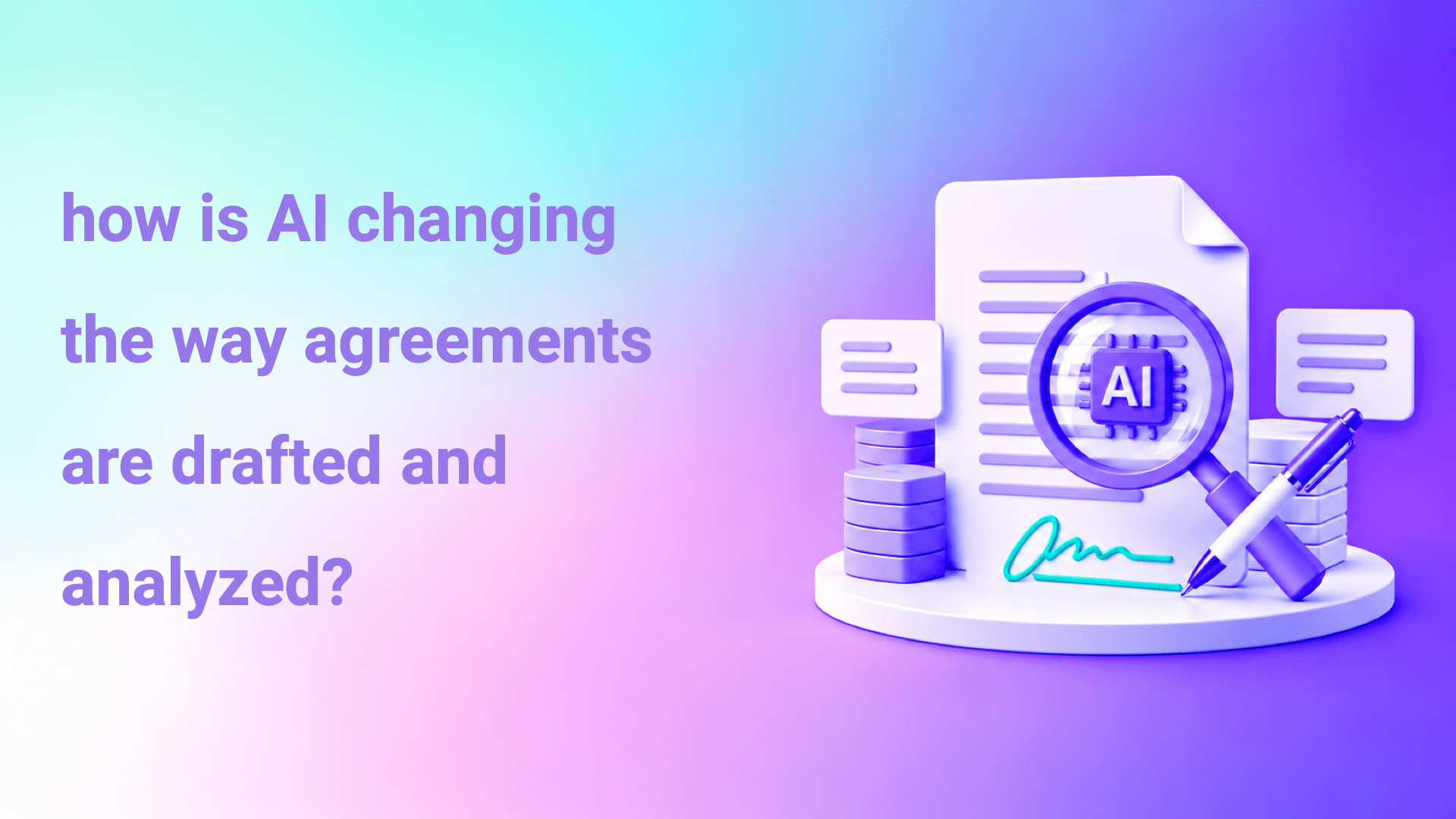
The future of contract management: how is AI changing the way agreements are drafted and analyzed?
In Saudi Arabia's fast-moving investment landscape, contracts are no longer just legal obligations filed away in drawers; they have become strategic assets that set the pace of an organization's growth. The real challenge today is not how to write a contract, but how to turn it from silent text into an intelligent entity that works in your favor. Relying on AI in contract management is what separates companies drowning in endless manual reviews from those adopting predictive management to anticipate risks and seize opportunities before they slip away.
In this article, we explore how Signit is reinventing the future of contracting, and how AI helps turn your contract cycle from a mere administrative procedure into a major competitive advantage that propels your organization to the forefront.
Table of contents
Why has AI become a strategic necessity?
Traditional digitization was a storage system, whereas the Signit CLM platform is a thinking system. The strategic need for AI lies in its ability to close three major gaps that large organizations struggle with:
- The silent data gap: Traditional contracts are inert documents, while AI turns them into live, analyzable data, ending the era of information lost inside long legal texts.
- The operational time gap: Instead of spending legal counsel's energy on routine tasks (such as matching data or searching for clauses), the system takes over these tasks, freeing human talent for strategic planning and managing major deals.
- The hidden risk gap: AI works like a legal radar that never sleeps; it detects conflicting clauses, monitors the parties' obligations, and ensures every contract is aligned with the organization's internal policies.
What does AI add to your contract management?
Deeper contract understanding
Turns long texts into clear, easy-to-use information.
Faster delivery
Significantly reduces the time needed to complete legal and administrative tasks.
Less reliance on manual work
Automates repetitive processes and eases the pressure on teams.
Early problem detection
Spots errors and risks before they escalate.
Support for growth and scale
Helps companies manage more contracts without added complexity.
Balancing business speed and legal complexity under Vision 2030
In a business environment moving at the scale of Vision 2030, executives face a dilemma: how do we sign deals quickly without sacrificing legal accuracy? This is where AI acts as a bridge connecting commercial agility with legal rigor:
- Agility: The system lets you generate and negotiate drafts in minutes, preventing disruptions to logistics and production operations.
- Compliance: Integration with sovereign systems (Nafath, Wathq) ensures that every fast move is 100% legal and documented, so speed and security run in parallel instead of colliding.
Automated agreement drafting: from traditional drafts to AI prompts

The first draft has always been the biggest time obstacle in the contract cycle, with lawyers spending hours copying clauses and aligning texts. Today, the Signit CLM platform redefines this stage by moving from manual writing to generation driven by AI prompts, turning strategic ideas into watertight legal texts in just a few minutes.
Turning ideas into contracts in minutes with smart templates and text prompts
Instead of starting from a blank page, the platform gives teams the ability to use generative AI to draft contracts from simple inputs. With the text prompt feature, users can describe the nature of the deal (for example, a one-year logistics services supply contract with a penalty clause for delays), and the system instantly generates a complete draft that intelligently incorporates the required clauses, taking into account the organization's specific commercial and legal context.
How does the Signit platform ensure consistent legal language and reduce reliance on manual drafting?
- Approved template library: The platform ensures that every contract generated from it follows the organization's house language, eliminating personal interpretations that could lead to legal loopholes.
- Built-in policy playbook: AI acts as a quality guardian, automatically checking that new clauses comply with internal compliance policies, which significantly reduces the need for repeated human reviews.
- Real-time collaboration and version control: With mentions and in-line comments inside the connected workflow, internal negotiation time is shortened, as the agreement is drafted and edited in a single central environment instead of copies scattered across emails.
Standardizing legal language in 5 points
Ready, approved templates
Standard templates that ensure the same legal style across all contracts, without individual interpretations.
Automatic smart review
The system checks that clauses comply with company policies without constant manual review.
Fewer human errors
A unified system reduces inconsistencies and gaps in drafting.
Instant in-platform collaboration
All edits and comments in one place instead of copies scattered across emails.
Major time savings
Less manual effort speeds up contract preparation and noticeably shortens turnaround time.
With this approach, contract drafting shifts from an administrative task to a smart technical process, giving legal counsel enough time to focus on strategic matters instead of getting lost in the routine details of drafting.
AI contract analysis: turning documents into actionable insights

The real power of AI contract analysis lies in its ability to analyze complex legal clauses and turn them into live digital data. In large organizations, obligations often stay locked in paper until a problem arises, but with the Signit platform, a contract goes from being a mere legal document to a dashboard that drives the organization's operational and financial performance.
Automatically extracting obligations and key milestones without human intervention
One of the biggest challenges in project management and logistics is tracking scattered deadlines and contractual obligations. The platform's AI works as an ultra-fast data analyst that:
- Identifies core obligations: Automatically extracts delivery dates, payment terms and quality standards from the body of the contract.
- Schedules milestones smartly: Instead of entering data manually into tracking systems, the system identifies the contract's key milestones and turns them into proactive alerts, ensuring that no contractual obligation that could trigger late penalties is missed.
- Reduces the human margin: Through full automation of the extraction process, the risk of oversight or error when transferring data from the contract to management systems is eliminated.
Analyzing contract trends by value and terms to support senior management decisions
The benefits of AI contract analysis are not limited to operations; they extend to strategy by giving senior management a comprehensive 360-degree view:
- Value maps: Analyze the distribution of contracts by financial value, helping CEOs understand where risks or opportunities are concentrated in specific sectors.
- Monitoring term patterns: Detect recurring terms that may cause bottlenecks in negotiating or executing contracts, enabling management to update the policy playbook and improve performance in future deals.
- Decision support: By turning hundreds of contracts into accurate visual reports, operations managers can make data-driven decisions about renewing agreements or renegotiating terms based on historical performance.
With these analytical insights, contract management shifts from a reactive function that steps in when crises occur to a proactive function that gives the organization full control over its contractual future.
Smart legal risk detection: your organization's digital guardian
In a complex business environment, the danger lies not in what we know, but in what escapes our eyes between the legal lines. This is where smart legal risk detection stands out as one of the most powerful tools of the Signit CLM platform, turning the system into a digital legal advisor that works around the clock to ensure every sentence in the contract is a shield protecting the organization, not a loophole threatening it.
Instant compliance checks based on internal legal playbooks
Large organizations adopt strict legal playbooks, but ensuring they are applied manually in every contract is a huge operational challenge. The platform's AI solves this dilemma through:
- Automated policy matching: As soon as a draft is uploaded or received from the other party, the system instantly reviews it and matches it against the organization's internal compliance standards.
- Detecting legal deviations: The system identifies clauses that fall outside the permitted scope (such as limitation of liability or indemnification terms) and issues instant alerts to legal counsel, preventing any contract that violates approved policy from going through.
Smartly suggesting alternative clauses based on deal context for the best legal protection
AI in the Signit platform does not just point out errors; it actively contributes to the negotiation stage by offering alternative solutions:
- Smart clauses: Based on the deal context and the counterparty, the system suggests ready-made alternative clauses pre-approved by the legal department, speeding up negotiation without compromising legal security.
- Balancing risks and opportunities: The system analyzes the clauses proposed by the other party and compares them with the organization's historical best practices, suggesting wording that balances protecting the organization's rights with the flexibility to close the deal.
Through this digital guardianship, contract review shifts from slow manual auditing to instant smart verification, giving operations managers and CEOs full confidence that every electronic signature is secure, protected and compliant with the highest legal standards.
See how AI for contracts works
Book a demo and we will map your playbooks and workflows to the right AI agents.
Smart text search: the power of information retrieval in the digital vault
In traditional systems, archives gradually turn into a black hole where data gets lost; finding a specific clause in an old contract can take hours of manual searching through folders or unclassified digital files. The Signit CLM platform offers a radical solution through smart text search, which turns the organization's contracts into information assets accessible in the blink of an eye.
An advanced search engine that processes thousands of documents in seconds (search within text and images)
The platform does not just search file names; it dives deep into the content thanks to advanced optical character recognition (OCR):
- Full-text search: You can search for a specific word or legal phrase (such as limitation of liability or late penalties) across thousands of contracts in just seconds.
- Overcoming format barriers: The smart engine can read text even inside scanned PDFs and images, meaning your old paper contracts that have been digitized become fully searchable, just like modern digital contracts.
Automatically classifying and tagging legacy contracts when importing them into the platform
Moving from paper to digital is an operational nightmare for most companies because of the sheer volume of data, but AI contract analysis at Signit makes this transition smooth and intelligent:
- Automatic indexing: When importing large volumes of legacy contracts, the system reads each contract and classifies it automatically by type (employment contract, supply agreement, lease), date and the parties involved.
- Metadata generation: AI extracts the metadata of each legacy contract (such as value, expiry date and authorized signatories), building you an organized database without your team having to enter data manually.
- Secure digital vault: These information assets are stored in encrypted digital vaults hosted locally in the Kingdom, with granular role-based access that ensures this sensitive information only reaches authorized hands.
Thanks to these technologies, contract management shifts from a logistical burden to an efficiency engine that lets decision-makers and legal teams retrieve any information or legal reference with pinpoint accuracy, supporting fast responses in ongoing disputes or negotiations.
Compliance and sovereignty: engineering AI for a compliant Saudi environment
In the software-as-a-service (SaaS) sector, the value of AI is only complete when paired with strict regulatory compliance, especially in Saudi Arabia, which places data sovereignty at the top of its priorities. The Signit CLM platform was not designed as a generic global tool; it was engineered to be structurally aligned with the Kingdom's digital and legislative infrastructure.
Aligning AI technologies with the requirements of the Digital Government Authority (DGA) and Nafath
The platform is a model of alignment between innovation and sovereign systems, integrating AI capabilities within a framework that respects the highest governance standards:
- Conclusive authentication via Nafath: AI outputs (generated contracts) are linked to signing flows based on the national digital identity, giving AI-generated contracts official legal standing before judicial authorities.
- Compliance with DGA controls: The platform complies with the requirements of the Digital Government Authority regarding electronic signatures and digital document management, giving decision-makers full peace of mind that AI in contract management is used within a licensed and accredited environment.
Data security and local AI hosting for complete privacy
At Signit, privacy is not just encryption; it is sovereignty of location:
- Fully local hosting: All data and AI operations are processed and stored on secure local servers in the Kingdom, ensuring organizations' sensitive data never leaves the country.
- Private AI models: AI algorithms are trained and run in isolated environments that prevent trade secrets or proprietary clauses from leaking from one organization to another, providing complete privacy befitting the largest government and private institutions.
Frequently asked questions about the future of contract management with AI (Signit CLM)
How will AI change the role of the legal counsel in contract drafting?
AI will not replace legal counsel; it will act as a highly intelligent assistant. Through automated agreement drafting and AI prompts, the legal professional's role will shift from routine text writer to strategic planner who oversees intelligent outputs, cutting the time lost to manual drafting by 65% and freeing them to focus on managing complex risks.
What is the smart legal risk detection feature offered by Signit CLM?
This feature is the organization's digital guardian: the system uses AI contract analysis to compare proposed clauses against internal legal playbooks. If a clause poses a risk or falls outside compliance standards, the system immediately flags it and suggests alternative clauses that protect the organization's rights according to the context of the deal.
Can AI read old scanned contracts (scanned PDFs)?
Yes. Thanks to smart text search and advanced image processing in the Signit platform, the system can interrogate old documents and classify them automatically. This means all your historical contracts become searchable, analyzable digital data, making it easy to extract obligations and key milestones even from paper archives that have been digitized.
How does AI help achieve compliance with Saudi Vision 2030?
It does so by enabling comprehensive legal digital transformation. By hosting data locally and complying with the standards of the Digital Government Authority (DGA), Signit CLM provides a smart contracting environment that accelerates business and attracts investment, while ensuring full digital sovereignty and identity verification through direct integration with Nafath.
Can AI be relied on to extract dates and financial obligations?
Absolutely. The system extracts obligations automatically without human intervention, identifying expiry dates, payment amounts and late penalties, and turning them into smart alerts on the dashboard. This feature protects senior management from the risk of human oversight and ensures 100% accuracy in contract execution.
What is the strategic return of moving to the Signit smart digital vault?
The return goes beyond secure storage; it is instant access to information. The digital vault lets management analyze contract trends by value and terms, supporting data-driven decisions and turning the legal department from a costly administrative unit into a smart engine that drives the organization's profitability and growth.
Final thoughts
The era when the legal department was seen as an obstacle to deal speed is over. Today, thanks to AI in contract management, it has become an engine that enables growth and protects the organization's assets with proactive intelligence.
Investing in the Signit CLM platform delivers tangible returns that go far beyond saving paper:
- Financial savings: Fewer penalties from missed renewal dates or legal loopholes, thanks to smart risk detection.
- Human efficiency: Redirecting legal counsel to focus on negotiation strategy instead of routine drafting, raising team productivity by up to 65%.
- Faster deal closing: Shrinking the contract lifecycle from weeks to days, which means faster cash flows and more flexible business relationships.
True digital transformation is not a future option; it is an operational reality that ambitious organizations are adopting today to be part of the Kingdom's Vision 2030. Don't leave your contract management to chance or to slow manual processes.
Start your automation journey now
Ensure your organization complies with the standards of the Digital Government Authority (DGA) with an integrated contract lifecycle management system, hosted locally and fully integrated with Nafath and Wathq.
Book a demoUseful external sources
- Saudi Electronic Transactions Law: Issued by royal decree, it sets out the legal validity of electronic signatures (via the Digital Government Authority website).
- National Center for Digital Certification (NCDC): The official reference for managing and inspecting digital certification services in the Kingdom (via the NCDC website).
- Cybersecurity regulations (National Cybersecurity Authority): Which govern data hosting policies and the protection of sensitive information within the Kingdom.
- Saudi Vision 2030 (National Transformation Program): Initiatives related to digitizing the private sector and raising administrative efficiency.